
File:Supercharging the Radiation Belts
Preview image: 1200 x 675 pixels.
Original file (Video file, video/mp4)
Captions
Captions
Add a one-line explanation of what this file represents
Summary
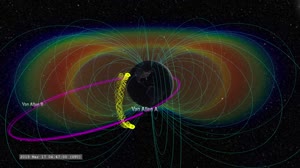
[edit]| Description | English: On March 17, 2015, an interplanetary shock – a shockwave created by the driving force of a coronal mass ejection, or CME, from the sun – struck the outermost radiation belt, triggering the greatest geomagnetic storm of the preceding decade. And NASA's Van Allen Probes were there to watch it. One of the most common forms of space weather, a geomagnetic storm describes any event in which Earth’s magnetic environment – called the magnetosphere – is suddenly, temporarily disturbed. Such an event can also lead to change in the radiation belts surrounding Earth, but researchers have seldom been able to observe what happens within the first few minutes immediately following a shock. But on the day of the March 2015 geomagnetic storm, one of the Van Allen Probes was located at just the right spot within the radiation belts, providing unprecedentedly high-resolution data from a rarely witnessed phenomenon. A paper on these observations was published in the Journal of Geophysical Research on Au |
| Date | |
| Source | NASA |
| Author | NASA |
| Permission (Reusing this file) |
This file is licensed under Public Domain (US Government Work). You are free to share and adapt this work as long as attribution is provided and changes are indicated. |
| Other versions |


File history
Click on a date/time to view the file as it appeared at that time.
| Date/Time | Thumbnail | Dimensions | User | Comment | |
|---|---|---|---|---|---|
| current | 09:39, 1 February 2026 | 1 min 37 s, 1,920 Ã 1,080 (23.36 MB) | Xenotron (talk | contribs) | Imported media from uploads:5fafaed2-ff50-11f0-afed-560e478790eb |
You cannot overwrite this file.
File usage on Commons
The following 6 pages use this file:
Transcode status
Update transcode statusFile usage on other wikis
The following other wikis use this file:
Metadata
- Space
- Solar System